Friday, 28 April 2023

Janki Navami

Important information
Janki or Sita Navami 2023
Saturday, 29 April 2023
Navami Tithi Begins - 28 April 2023 at 04:01 PM
Navami Tithi Ends - 29 April 2023 at 06:22 PM
About Sita Navami
Sita Navami, also known as Sita Jayanti, marks the birth anniversary of Goddess Sita, the consort of Lord Rama. The day is also famous as Janki Navami. On the day, married women observe a fast for the long lives of their husbands, just the way Sita Mata prayed for Lord Rama’s life and well-being while she was abducted by Ravana.

Sita Jayanti Dates
As per the Hindu calendar, the festival of Sita Navami falls on Navami tithi (ninth day) during Shukla Paksha in the month of Vaisakh. According to the Gregorian calendar, the day falls in the month of April or May. Lord Rama was born on Navami of Chaitra month, and Rama Navami is observed exactly a month before Sita Navami.

Significance of Sita Navami
By observing a fast on Janaki Navami, women seek longevity for their husbands’ lives. Goddess Sita, regarded as the incarnated form of Goddess Lakshmi, was born in Mithila. She is also known by the names of Janaki, Bhoomija, and Maithili.

Goddess Sita is revered as the epitome of purity, sacrifice, dedication, courage, and patience. It is believed that women who observe the Sita Navami fast are bestowed with the divine blessings of the Goddess and a blissful married life.

Rituals of Sita Navami
Devotees worship Lord Rama, Goddess Sita, and Lakshman together by arranging a mandap and setting the idols of the deities.
The mandap, or place of worship, is decorated with flowers and garlands.
Along with Goddess Sita, devotees also worship Goddess Earth as the deity is said to have emerged out of earth.
Along with puja, devotees offer fruits, sesame seeds, barley, and rice to the deities.
Devotees also prepare Satvik food, which is first offered to the deities and then distributed among family members or invitees after completion of the aarti.
Women observe a strict fast through the day and refrain from consuming water and food.
At various temples of Lord Rama and Goddess Sita, huge celebrations are witnessed and various rituals like Maha Aarti, Maha Abhishekam, and Sringaar Darshan are held.
Bhajans, kirtans and recitals of Ramayan are held at several places.
Processions are carried out with the idols of deities placed in decked up chariots, as devotees sing and dance on devotional songs and chant ‘Jai Siya Ram’ along the way. life.

जानकी नवमी: 29 April 2023

जानकी नवमी के बारे में
जानकी नवमी, जिसे सीता जयंती के रूप में भी जाना जाता है, भगवान राम की पत्नी, देवी सीता की जयंती का प्रतीक है। यह दिन जानकी नवमी के नाम से भी प्रसिद्ध है। इस दिन, विवाहित महिलाएं अपने पति की लंबी उम्र के लिए उपवास रखती हैं, ठीक उसी तरह जैसे सीता माता ने रावण द्वारा अपहरण किए जाने के दौरान भगवान राम के जीवन और कल्याण के लिए प्रार्थना की थी।
सीता जयंती तिथियां
हिंदू कैलेंडर के अनुसार, सीता नवमी का त्योहार वैसाख के महीने में शुक्ल पक्ष के दौरान नवमी तिथि (नौवें दिन) को पड़ता है। ग्रेगोरियन कैलेंडर के अनुसार यह दिन अप्रैल या मई के महीने में आता है। चैत्र मास की नवमी को भगवान राम का जन्म हुआ था और सीता नवमी से ठीक एक महीने पहले राम नवमी मनाई जाती है।

सीता नवमी का महत्व
जानकी नवमी का व्रत रखकर महिलाएं अपने पति की लंबी आयु की कामना करती हैं। देवी सीता, जिन्हें देवी लक्ष्मी का अवतार माना जाता है, का जन्म मिथिला में हुआ था। उन्हें जानकी, भूमिजा और मैथिली के नामों से भी जाना जाता है।

देवी सीता को पवित्रता, त्याग, समर्पण, साहस और धैर्य के प्रतीक के रूप में पूजा जाता है। ऐसा माना जाता है कि जो महिलाएं सीता नवमी का व्रत रखती हैं, उन्हें देवी के दिव्य आशीर्वाद और आनंदमय वैवाहिक जीवन की प्राप्ति होती है।

जानकी नवमी के अनुष्ठान
भक्त भगवान राम, देवी सीता और लक्ष्मण की एक साथ एक मंडप की व्यवस्था करके और देवताओं की मूर्तियों की स्थापना करके पूजा करते हैं।

मंडप या पूजा स्थल को फूलों और मालाओं से सजाया जाता है।

देवी सीता के साथ, भक्त देवी पृथ्वी की भी पूजा करते हैं क्योंकि कहा जाता है कि देवी पृथ्वी से निकली हैं।

पूजा के साथ, भक्त देवताओं को फल, तिल, जौ और चावल चढ़ाते हैं।

भक्त सात्विक भोजन भी तैयार करते हैं, जिसे पहले देवताओं को अर्पित किया जाता है और फिर आरती पूरी होने के बाद परिवार के सदस्यों या आमंत्रितों के बीच वितरित किया जाता है।
महिलाएं पूरे दिन कड़ा उपवास रखती हैं और पानी और भोजन का सेवन नहीं करती हैं।

भगवान राम और देवी सीता के विभिन्न मंदिरों में, विशाल उत्सव देखे जाते हैं और महा आरती, महा अभिषेकम और श्रृंगार दर्शन जैसे विभिन्न अनुष्ठान आयोजित किए जाते हैं।

कई स्थानों पर भजन, कीर्तन और रामायण का पाठ होता है।

जुलूसों को अलंकृत रथों में देवताओं की मूर्तियों के साथ किया जाता है, क्योंकि भक्त भक्ति गीतों पर गाते और नृत्य करते हैं और रास्ते में 'जय सिया राम' का जाप करते हैं।

Friday, 21 April 2023

ELECTRICITY LESSON PLAN

Learning Objectives
Upon completion of this lesson, students will be able to:

define 'electricity'
distinguish between static and current electricity
list the ways we use electricity each day
experiment with electricity and conductors

Key Vocabulary
Electricity
Static electricity
Current electricity
Conductors
Materials
The quiz associated with this text lesson
Balloons
Tinsel
Yarn

Instructions
Begin by turning off the lights in the cla
ssroom for five seconds.
Now turn them back on for five seconds, off again for two seconds, and then back on.

Ask the students to consider what was happening as the light flickered in class and discuss this briefly as a class.

Now have the class read the 'What Is Electricity?' section of the text lesson What is Electricity? - Lesson for Kids.
Did anyone mention electricity in the class discussion?

Now ask them to consider of there are different types of electricity. Discuss this briefly as a class.
Instruct the students to read the 'Static Electricity' section of the text lesson now.

When they have finished reading, have them stand up and practice rubbing their shoes quickly on the carpet and touching one another gently on the fingers to see if they can create static electricity.

Objectives:

Students will be able to name the name parts of an atom.

Students will be able to describe the critical part of an atom responsible for electricity.

Students will be able to define electricity.

Students will be able to design a simple circuit making one light bulb light.

Students will be able to define current electricity.

Students will be able to identify the main parts of a simple circuit.
Students will be able to draw and interpret simple circuit diagrams


An open switch creates an air gap across which the electrons cannot flow meaning the load or loads do not receive the energy from the electrons and they do not work.
An electric circuit must travel in a circular pattern. It begins at the negative terminal of the source and ends at the positive terminal of the source.

Discussion Questions
What would our lives be like without electricity?
Which type of electricity do we experience most often?

Sunday, 16 April 2023

रॉबिन सिंह

रॉबिन सिंह पर्यावरण संरक्षण का संदेश लेकर तमिलनाडु के कन्या कुमारी से साइकिल यात्रा पर निकले है। उत्तर प्रदेश के इटावा जिले के रहने वाले रोबिन सिंह बृहस्पतिवार (13/04/2023) को  के रुन्नीसैदपुर पहुंचे। यहां हां उनका जोरदार स्वागत किया गया।
ज्ञान भारती पब्लिक स्कूल, रुन्नीसैदपुर में बृहस्पतिवार की सुबह 10:30 बजे साइकिल यात्रा पर निकले युवक रोबिन सिंह का निदेशक श्री राम भद्र, शिक्षक निखिल सिंह, संजीव गुप्ता, अशोक साहनी, धर्मेन्द कुमार, विक्रम सिंह, सत्येंद्र सिंह, सुनील सिंह, निर्दोष कुमार ने गर्मजोशी से स्वागत किया.

इस अवसर पर ज्ञान भारती की कक्षाओं में उपस्थित छात्र-छात्राओं को संबोधित करते हुए रोबिन सिंह ने कहा कि आज पर्यावरण तेजी से प्रदूषित हो रहा है. पर्यावरण की रक्षा के लिए हम सभी को एकजुट होने की जरूरत है। आज लोग भौतिक सुख-सुविधाओं के लिए हरे पेड़ों को काट रहे हैं। बारिश से कई जिलों में हाहाकार मच गया है. किसान आसमान की ओर देख रहे हैं।
उन्होंने बताया कि वे पर्यावरण संरक्षण के प्रति आम लोगों को जागरूक करने के उद्देश्य से विगत 06 अक्टूबर 2022 से तमिलनाडु के कन्या कुमारी से साइकिल यात्रा पर हैं तथा केरल, कर्नाटक, आंध्र प्रदेश, ओडिशा, झारखंड, पश्चिम बंगाल, असम, मेघालय त्रिपुरा से मणिपुर होते हुए बिहार पहुंचे है। उन्होंने बताया कि वह अब तक 12 हजार 821 किमी साइकिल चला चुके हैं। 

Wednesday, 12 April 2023

There is evidence that the universe did not begin with the Big Bang. And now?

There is evidence that the universe did not begin with the Big Bang. And now?
Was the Big Bang really the beginning of everything? According to more recent studies on the limits of the observable universe , no. Scientists have already obtained enough consistent evidence to support the hypothesis of an earlier period — known as cosmic inflation —, responsible for “setting up” the cosmos before matter filled it. Meet some of them.

There are two prevailing ideas about the Big Bang: that of a singularity that gave rise to everything, and that of cosmic inflation. The first — and most popular — says that all the energy and matter in the universe was confined to a single point of infinite density, while the second dismisses that possibility.

There are some reasons to reject the idea of ​​singularity, such as the very concept of a single point in the universe where everything would be concentrated. As much as it is inevitable in the Theory of General Relativity, the singularity “breaks” mathematics and physics ceases to make sense.

Furthermore, observations of the cosmic background radiation — the remaining light that confirms the Big Bang theory — show that even at the very beginning of the universe there was already a certain configuration, a kind of “fingerprint”, which resulted in mass concentrations and “voids” distributed throughout the cosmos.

Imperfections of the cosmic background radiation

 In the first moments after the Big Bang, the universe was hot and dense , formed by a plasma of photons, electrons and baryons. As the universe expanded, the plasma spread out, cooling until electrons could join with protons to form hydrogen and helium atoms.

Only then could electrons travel freely through space, which resulted in the cosmic microwave background radiation (CMB) — an afterglow emitted about 380,000 years after the start of the Big Bang. We cannot observe anything beyond this period, as photons could not travel to us.

Although the CMB is isotropic (has the same physical properties anywhere in the universe), it does show some temperature fluctuations (anisotropy, or imperfections, with some areas hotter than others), which implies differences in energy concentration. And, as Albert Einstein demonstrated with the formula E=mc² , energy is matter—and vice versa.

Thus, such CMB fluctuations correspond to superdense and subdense regions in the cosmos. As the universe expands and cools, the superdense regions will attract more matter and energy, growing over time; meanwhile, the underdense regions will yield matter and energy to the denser ones, becoming empty “bubbles”.

This distribution served as a kind of seed to form the cosmic structures we see today, with clusters of galaxies and the great cosmic web, and any theory about the beginning of the universe needs to explain this phenomenon.

Singularity x cosmic inflation

According to the Big Bang with a singularity explanation, the universe was simply "born" with this set of fluctuations that grew and evolved to result in the gravitational collapse of matter as dense areas drew matter towards them.

As for the theory of cosmic inflation, where the Big Bang appears only after an inflationary period, these imperfections observed in the CMB had already been seeded by quantum fluctuations. The theory that supports this idea is the energy-time uncertainty relation.

These quantum fluctuations are generated at the smallest scales and stretched to larger scales by cosmic inflation, while later and later fluctuations are stretched over the former, creating a superposition of fluctuations at all distance scales.

Ultimately, these superimposed fluctuations spread throughout the cosmos, cause the density imperfections in the early universe, which in turn lead to the temperature fluctuations we measure in the cosmic microwave background. In other words, quantum fluctuations shaped the anisotropy of the universe even before the Big Bang.

The fluctuations on the largest scales could indeed have been created from the fluctuations that arose during the inflationary period before the Big Bang, but there is also another possible explanation: the gravitational growth of structure in the most evolved universe, which has a very distant cosmic horizon. larger than the early universe.

 This requires more concrete evidence to strengthen the inflationary model. And they have already been found. One is that if the temperature before a trillionth of a second after the birth of the universe were high enough to allow us to guess the singularity, there would be gravitational waves in the polarization of the cosmic background radiation.

However, in the most recent measurements of the cosmic microwave background this temperature has never been higher than about 10¹⁵ GeV, in terms of energy. This implies a minimum size limit . For a time of 10⁻³⁵ seconds, we have a scale of approximately 1.5 meters, so the universe could not be smaller than that in its most primordial stage.

Perhaps the strongest evidence for cosmic inflation is the universe's superhorizon fluctuations: a limit to how far a signal could travel at the speed of light since the beginning of the Big Bang. This boundary is known as the cosmic horizon, while beyond it lies the super-horizon. Below the threshold is the sub-horizontal scale.

When the WMAP satellite observed in 2003 a correlation between polarized light and temperature fluctuations in the cosmic microwave background radiation, scientists gained a powerful tool: temperature fluctuations could finally be measured on each of these horizon, super-horizon scales. and sub-horizon.

Why is that so important? It's just that both models—singularity and cosmic inflation—make predictions about these measurements, and they all match predictions of an inflationary period before the Big Bang.

On the other hand, signals that appear on superhorizon scales shouldn't appear at all if the universe had started with a singularity.

In the image above, the dotted line represents the prediction of the singularity model, while the solid line in waves corresponds to the predictions of cosmic inflation. WMAP observations validated the solid line.

In 2015, the Plank satellite made even more precise observations of superhorizon fluctuations, in a greater number of wavelength ranges, with greater sensitivity to temperature. The final correlation data (below) is even more favorable for cosmic inflation.

This graph, with the observed fluctuations in the super-horizon, demonstrates that the Big Bang singularity model does not match the universe that astronomers observe.

What about the Big Bang theory?
One of the most recurrent explanations of the Big Bang is: if the universe is constantly expanding, we can go back in time until we reach a point where everything boils down to a simple point — the singularity.

However, the graphs above show that we can only go back so far. Prior to that moment, an inflationary state multiplied space in all three dimensions every trillionth of a second, shaping the universe with the quantum fluctuations that determined regions of high and low density.

The multiverse may be inevitable

 If the universe existed before the Big Bang and was expanding on unimaginable scales, could other Big Bangs have happened, giving rise to other universes ? Depending on how you observe it, our universe would only have a chance to exist if others were also born.

Our universe is perfectly fine-tuned to support everything we observe — galaxies, stars, planets, life. So far, scientists still cannot say whether this was luck or the result of some other “rule” beyond our understanding.

This rule could well be the probabilistic one: if a large number of Big Bangs had given rise to endless other universes, the tiniest difference in the quantum fluctuations between them could result in some successful universes and other stillborn universes.

According to String Theory (not yet proven observationally), reality consists of about 11 dimensions, 8 of them so compact that we can't see them. Each type of compaction could create a universe with different physical properties, and the laws of probability would cause other Big Bangs to have these differences from ours.

Therefore, other universes may be governed by different laws, with exotic physics, gravity working in other ways, and so on. In fact, recent research suggests that universes even friendlier to life than ours may exist, although most could be born "failures".

Of course, none of this can be proven, but the possibilities of finding evidence are real. But, first of all, scientists will still have work to find more evidence for the cosmic inflation model, until it is, in a way, unquestionable.

Source: The Astrophysical Journal , University of Chicago , ESA ; via: Starts With a Bang

 1_Chris Blacke/Sam Moorfield

 2_Graph of the expansion of the universe throughout its history (Image: Reproduction/Alex Mittelmann/Coldcreation)

3_Successive improvements in observations of anisotropies, or temperature fluctuations in the cosmic background radiation (Image: Reproduction/NASA)

4_The fluctuations in the cosmic background radiation indicate where the densest regions formed galaxy clusters.

 5_Hot, cold, and average temperature regions in the cosmic background radiation correspond to subdense, superdense, or medium density regions at the time it was emitted, 380,000 years after the Big Bang (Image: Reproduction/E. Siegel/Beyond the Galaxy )

6_Results from WMAP observations favor the cosmic inflation model (Image: Reproduction/A. Kogut et al./ApJS, 2003/Notes by E. Siegel)

7_Results of the Plank satellite observations (Image: Reproduction/ESA/Planck Collaboration; notes by E. Siegel)

8_How many universes are there besides ours? (Image: Reproduction/Geralt/Pixabay)
Sunday, 2 April 2023

Neeta Ambani's Graceful Performance

The opening act is a performance titled ‘The Great Indian Musical: Civilization to Nation’,
Mumbai: After last night’s star-studded grand opening ceremony of the Nita Mukesh Ambani Cultural Centre left everyone awestruck. A video of Nita Ambani’s graceful performance at the centre’s Grand Theatre has gone viral on social media. In the post shared by NMACC’s Twitter handle, Nita Ambani can be seen dancing to ‘Raghupati Raghav Raja Ram’ for the premiere of ‘The Great Indian Musical: Civilization to Nation.’ The Grand Theatre is the crown jewel of the Nita Mukesh Ambani Cultural Centre. With state-of-the-art facilities that have never been seen before in India, the expansive space offers audiences the opportunity to witness performance art at an entirely new scale. #NMACC नीता मुकेश अंबानी सांस्कृतिक केंद्र, मुंबई, भारत। नीता एम अंबानी नीता एम अंबानी एक शिक्षाविद, परोपकारी, व्यवसायी, खेल उत्साही, कला की संरक्षक और महिलाओं और बच्चों की एक आदर्श चैंपियन हैं। वह रिलायंस फाउंडेशन की संस्थापक अध्यक्ष के रूप में, एक पहल जिसने 63 मिलियन से अधिक भारतीयों को सशक्त बनाया है, उन्हें एक सकारात्मक और स्थायी आजीविका के लिए संसाधन और अवसर प्रदान किए हैं। नीता वेलनेस को सर्वोत्कृष्ट बनाने के लिए प्रतिबद्ध हैं; और रिलायंस फाउंडेशन की विभिन्न पहलों के माध्यम से सभी भारतीयों के लिए गुणवत्तापूर्ण स्वास्थ्य सेवा सुलभ और सस्ती। उनके नेतृत्व में, सर II। एन. रिलायंस फाउंडेशन हॉस्पिटल एंड रिसर्च सेंटर मुंबई का नंबर 1 अस्पताल बन गया है।

Saturday, 1 April 2023

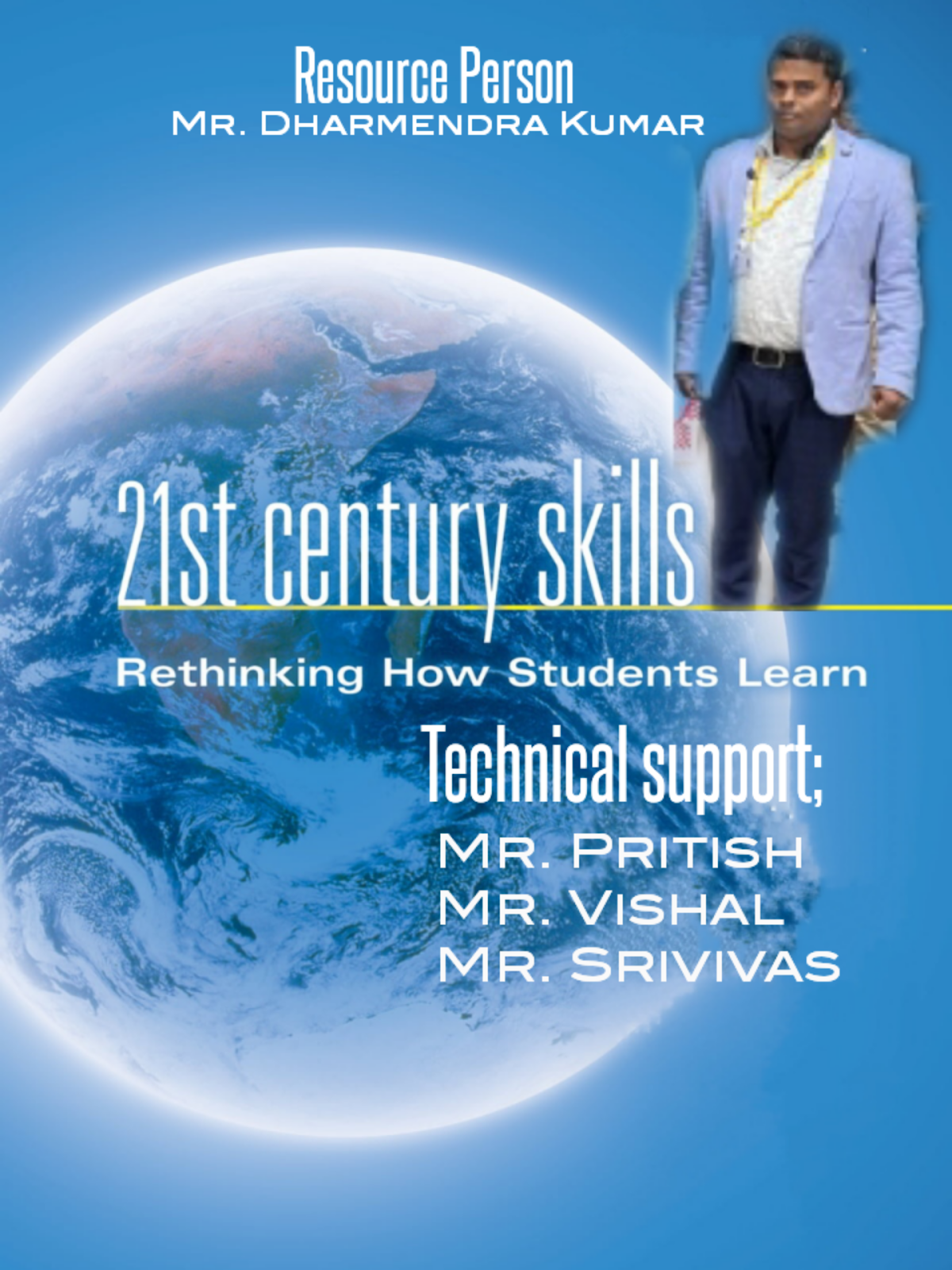
21st Century skill (CBSE Teachers Training Session 5) 29 March 2023

What Are 21st Century Skills?
Resource Person: Mr. Dharmendra   
(March 29 , 2023 2:00:00 PM)
21st Century skills are 12 abilities that today’s students need to succeed in their careers during the Information Age.
The twelve 21st Century skills are
1. Critical thinking
2. Creativity
3. Collaboration
4. Communication
5. Information literacy
6. Media literacy
7. Technology literacy
8. Flexibility
9. Leadership
10. Initiative
11. Productivity
12. Social skills

These skills are intended to help students keep up with the lightning-pace of today’s modern markets. Each skill is unique in how it helps students, but they all have one quality in common.
(a) What’s included in 21st Century skills? 
(b) How they help students, and why they’re so important.

To start, let's dive into the three categories that 21st Century skills fall into.


The Three 21st Century Skill Categories
Each 21st Century skill is broken into one of three categories:
1. Learning skills
2. Literacy skills
3. Life skills

Learning skills (the four C’s) teaches students about the mental processes required to adapt and improve upon a modern work environment.
Literacy skills (IMT) focuses on how students can discern facts, publishing outlets, and the technology behind them. There’s a strong focus on determining trustworthy sources and factual information to separate it from the misinformation that floods the Internet.

Life skills (FLIPS) take a look at intangible elements of a student’s everyday life. These intangibles focus on both personal and professional qualities.

Altogether, these categories cover all twelve 21st Century skills that contribute to a student’s future career.

This is not an exhaustive checklist of career readiness skills — but they're the career readiness skills that overlap with 21st Century skills!
Category 1. 
Learning Skills (The Four C’s) 21st-century-learning-skills

The four C’s are by far the most popular 21st Century skills. These skills are also called learning skills.

More educators know about these skills because they’re universal needs for any career. They also vary in terms of importance, depending on an individual’s career aspirations.

The 4 C's of 21st Century Skills are:
Critical thinking: Finding solutions to problems
Creativity: Thinking outside the box
Collaboration: Working with others
Communication: Talking to others

               (हिन्दी अनुवाद)।     

21वीं सदी के कौशल क्या हैं?
संसाधन व्यक्ति: श्री धर्मेंद्र
(29 मार्च 2023 2:00:00 अपराह्न)

21वीं सदी के कौशल 12 क्षमताएं हैं जो आज के छात्रों को सूचना युग के दौरान अपने करियर में सफल होने के लिए चाहिए।

21वीं सदी के बारह कौशल हैं:
1. आलोचनात्मक सोच
2. रचनात्मकता
3. सहयोग
4. संचार
5. सूचना साक्षरता
6. मीडिया साक्षरता
7. प्रौद्योगिकी साक्षरता
8. लचीलापन
9. नेतृत्व
10. पहल
11. उत्पादकता
12. सामाजिक कौशल

इन कौशलों का उद्देश्य छात्रों को आज के आधुनिक बाजारों की बिजली की गति के साथ बनाए रखने में मदद करना है। प्रत्येक कौशल अद्वितीय है कि यह छात्रों की मदद कैसे करता है, लेकिन उन सभी में एक गुण समान है।

क) 21वीं सदी के कौशल में क्या शामिल है?
(बी) वे छात्रों की मदद कैसे करते हैं, और वे इतने महत्वपूर्ण क्यों हैं।

शुरू करने के लिए, आइए उन तीन श्रेणियों में गोता लगाएँ जिनमें 21वीं सदी के कौशल आते हैं।
21वीं सदी की तीन कौशल श्रेणियां
प्रत्येक 21वीं सदी के कौशल को तीन श्रेणियों में विभाजित किया गया है:
1. सीखने का कौशल
2. साक्षरता कौशल
3. जीवन कौशल

श्रेणी 1।
लर्निंग स्किल्स (द फोर सी) 21 वीं सदी-सीखने-कौशल

चार सी 21वीं सदी के अब तक के सबसे लोकप्रिय कौशल हैं। इन कौशलों को अधिगम कौशल भी कहा जाता है।

अधिक शिक्षक इन कौशलों के बारे में जानते हैं क्योंकि वे किसी भी करियर के लिए सार्वभौमिक आवश्यकताएं हैं। वे किसी व्यक्ति की करियर आकांक्षाओं के आधार पर महत्व के मामले में भी भिन्न होते हैं।

साक्षरता कौशल (IMT) इस बात पर ध्यान केंद्रित करता है कि छात्र तथ्यों, प्रकाशन आउटलेट्स और उनके पीछे की तकनीक को कैसे समझ सकते हैं। इंटरनेट पर बाढ़ आने वाली गलत सूचनाओं से अलग करने के लिए भरोसेमंद स्रोतों और तथ्यात्मक जानकारी का निर्धारण करने पर एक मजबूत ध्यान है।

जीवन कौशल (फ्लिप्स) एक छात्र के दैनिक जीवन के अमूर्त तत्वों पर एक नज़र डालते हैं। ये इंटैंगिबल्स व्यक्तिगत और व्यावसायिक दोनों गुणों पर ध्यान केंद्रित करते हैं।

कुल मिलाकर, ये श्रेणियां 21वीं सदी के सभी बारह कौशलों को कवर करती हैं जो एक छात्र के भविष्य के करियर में योगदान करते हैं।

यह करियर तैयारी कौशल की एक विस्तृत चेकलिस्ट नहीं है - लेकिन वे करियर तैयारी कौशल हैं जो 21वीं सदी के कौशल के साथ ओवरलैप करते हैं!


21वीं सदी के कौशल के 4 सी हैं

सीखने के कौशल (चार सी) छात्रों को आधुनिक कार्य वातावरण में अनुकूलन और सुधार के लिए आवश्यक मानसिक प्रक्रियाओं के बारे में सिखाते हैं।

गंभीर सोच: समस्याओं का समाधान खोजना
रचनात्मकता: बॉक्स के बाहर सोच
सहयोग: दूसरों के साथ काम करना
संचार: दूसरों से बात करना

Winners

विज्ञान कहता है कि एक वयस्क स्वस्थ पुरुष एक बार संभोग के बाद जो वीर्य स्खलित करता है, उसमें 400 मिलियन शुक्राणु होते हैं...... ये 40 करोड़ श...